


By Emily Stonehouse
While life ticked on this week, a heavy cloud loomed over the County of Haliburton.
Quite literally.
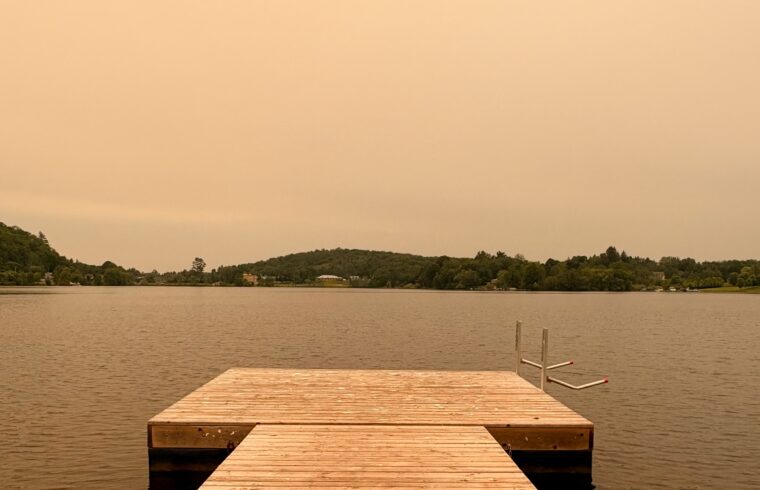
Rolling in on Wednesday, July 15, smoke from northwestern forest fires seeped into the communities, forcing air quality warnings from Lakelands Public Health.
The alerts came on the heels of an extreme heat warning, prompting cooling centres to open up where possible, while temperatures lingered around 34 degrees Celsius.
While the heat and humidity broke Tuesday evening, smoke rolled in through the night, with the community waking up to eerie yellow skies on Wednesday morning.
As of Thursday, July 16, there were over 180 active wildland fires burning in Ontario.
Air Quality Health Index (AQHI) originally noted Haliburton County as a yellow level on Wednesday, but by Thursday morning, the organization had shifted up to orange.
“During heavy smoke conditions, everyone’s health is at risk regardless of their age or health status,” said Environment Canada. “Limit time outdoors. Reschedule or cancel outdoor sports, activities and events.”
While normal levels of air quality range between one or two, Thursday morning levels were registering between eight and nine on the AQHI.
Concerns with smoke exposure include but are not limited to symptoms such as eye, nose and throat irritation, headaches or a mild cough. More serious, but less common symptoms include wheezing, chest pains or severe cough.
People aged 65 and older, pregnant people, infants and young children, people with an existing illness or chronic health condition, and people who work outdoors are more likely to be impacted by wildfire smoke. It was noted that individuals should avoid strenuous activities outdoors, and seek medical attention if experiencing symptoms.
Haliburton Grassroots Soccer, a league that supports over 200 youth throughout the summer months, made the decision to cancel both the Tuesday sessions, as well as the Thursday night games. For an organization that prides itself on running rain or shine, the unprecedented weather left them in a difficult position.
“As much as I’m gutted to cancel another soccer night, I don’t want to put any of our kids in harm’s way,” said Kathy Judson, the coordinator of the league. “Before 7 a.m. I already had a scratchiness at the back of my throat just being outside for a few minutes, so we can’t possibly do any high intensity cardiovascular activities in this.”
Judson noted that traditionally, soccer is a mild weather sport, slated for the spring or fall seasons. But with limited local access to large fields, the venue is only available during summer months when school is not in session. “We have such a short window to access the only fields in town and it’s so sad when weather or environmental factors cut our time even shorter,” said Judson. “Cancelling soccer is not a huge deal if we consider what some of our northern neighbours are dealing with. It’s an inconvenience for sure, but things could be way worse.”
While the wildfire smoke continued, social media users were taking to their platforms, curious about a fire ban. Currently there is no ban in place, but regulations outline that burning is only permitted before 7 a.m. and after 7 p.m.
“The four fire chiefs of the county are checking conditions daily in conjunction with the Ministry of Natural Resources and Forestry (MNRF),” said Dan Chumbley, the chief in Dysart. “We don’t make the decision lightly, and will implement for a one week minimum if/when we do.”
Chumbley noted that overall, he has been impressed with the general public during this dry season, noting that the majority have been well informed, and are taking it upon themselves to be more cautious.
MPP Laurie Scott noted the health concerns associated with the wildfire smoke. “Please don’t go outside if you don’t have to,” she said. “We have a good community here in Haliburton County, remember to check on your loved ones and neighbours.”
Scott said that she feels the provincial government is doing everything they can to support the firefighting efforts. “Our government is sparing no expense and coordinating with impacted communities to ensure safe evacuation efforts where needed,” she said. “We will continue to dedicate all the resources necessary to respond to these fires and to keep people safe.”
According to this year’s provincial budget, Ontario has spent $271 million on emergency firefighting. That original budgeted amount was $135 million, but went well over the allocated amount due to a difficult fire season last summer.
Under the leadership of Premier Doug Ford, the province’s budget for 2026-2027 emergency firefighting has been set for $150 million.
While the fires may seem far away, Carnarvon local Kim Switzer felt them near and dear to her heart.
Switzer’s 14-year-old son, Memphis, has been backcountry camping with Keewaydin Camp since early this summer. Now in his fourth year of the canoe tripping camp, Switzer firmly believes in what the camp offers for youth. “It’s been such a need for a kid like Memphis,” she said during a recent interview. “Being in the outdoors is what grounds us. Being outdoors has become home.”
But nothing could have prepared her for this season.
During a routine multi-day trip, the fires surrounding the sites began to escalate. Switzer received a message from the camp, saying that they were putting an evacuation order in place. The campers were paddling an area around Armstrong and Collins First Nation. “I realized that things were getting very serious,” said Switzer. “As a mom, you’re feeling helpless. You’re trying not to have fear, or picture that worst case scenario in your mind. But I couldn’t even look out the window without seeing smoke here, and you can’t get away from it.”
With the campers encouraged to go screen free for the duration of their experience, Switzer had no direct contact with her son. But she gives major credit to the camp for their professionalism and navigation of the difficult task. “Hats off to them,” she said. “I can only imagine what all these staff members are going through. What an amazing team of hardworkers.”
While the camp worked diligently to remove the groups from the high risk zones, the first group was taken out by float plane, the second was removed via helicopter, but the last group – the one that Memphis was a part of – needed to take refuge at a small island for a night while they waited for evacuation.
“I didn’t sleep at all that night,” said Switzer. By the next morning, parents had been notified that plans had changed. “The boys had to get back to the train station, to be dropped off at a small town to meet police, and get on a bus to Sioux Lookout.”
Finally, Switzer got notice that Memphis had made the bus. “I was told that the boys are out of harm’s way,” she said, “and they are en route to safety.”
Switzer hopes that this experience doesn’t instill fear in the hearts and minds of campers, rather, it teaches them resilience, and gives them confidence for navigating this ‘new normal’ of climate change. “I hope it gives them experience for the lands up there,” she said. “And I really do hope they can look back on this experience, knowing that it was something they overcame as a team, as a family.”
At the time of press, the air quality has returned to normal levels, and there is not a full fire ban in place. Burning is only permitted between 7 p.m. and 7 a.m., and further questions can be directed to local municipal fire stations.